GBSB Global Joins Forbes Catalonia Economic Summit 2026 to Discuss Talent, Education and the Future of Work
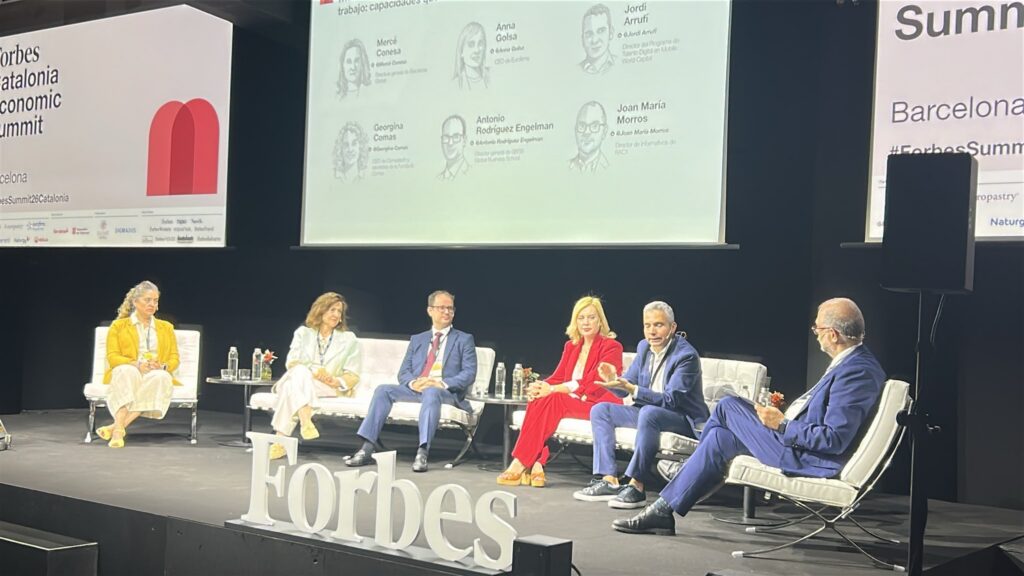
On June 23, GBSB Global Business School participated in the Forbes Catalonia Economic Summit 2026 at the Teatre del Liceu in Barcelona. The summit featured a high-level discussion on Catalonia’s economic, industrial, technological, and social future.
Under the theme “Catalonia towards Europe: From Geopolitics to Economic, Industrial, and Technological Strength,” the summit brought together institutional leaders, business executives, academics, and civil society representatives to discuss the factors that will influence Catalonia’s future competitiveness.
Antonio Rodríguez Engelmann, the managing director of GBSB Global Business School, joined the roundtable discussion, “Talent, Education, Alliances, and the Future of Work: Capabilities that Will Define a Competitive Catalonia.” The session explored how Catalonia, and Barcelona in particular, can strengthen their position as territories capable of attracting, generating, and developing talent by connecting education, employability, business, and applied knowledge.
The panel brought together leading voices from the business, education, talent, and innovation ecosystems. Participants included Georgina Comas, CEO of Comastech and Secretary of Fundació Comas; Mercè Conesa, General Director of Barcelona Global; Anna Golsa, CEO of Eurofirms; and Jordi Arrufí, Director of the Digital Talent Program at Mobile World Capital. Joan María Morros, News Director at RAC1, moderated the session.
GBSB Global’s participation placed international business education at the heart of the conversation on Catalonia’s future competitiveness. As companies face accelerated technological change, new professional profiles, and increasingly global labor markets, higher education institutions play a decisive role in preparing graduates who can confidently navigate business, technology, innovation, and multicultural environments.
For GBSB Global, the debate was especially relevant. The school’s academic model is built around internationalization, digital transformation, entrepreneurship, innovation, and employability — the same dimensions that are now redefining the future of work. With a diverse student body, campuses in Barcelona, Madrid, and Malta, and a robust online learning ecosystem, GBSB Global prepares students to develop the strategic, technological, and cross-cultural skills required by a rapidly changing economy.
Rodríguez Engelmann’s presence at the summit reinforced the importance of connecting education with real business needs.
In his presentation, Rodríguez Engelmann highlighted the concrete risks and benefits of artificial intelligence applications in the entrepreneurial and business sectors. He also emphasized the need to develop a pool of young talent capable of mastering this technology. “How can we develop human talent in Catalonia to meet the challenges posed by artificial intelligence? How can human and artificial intelligence collaborate and interact? These are the challenges we will have to face now and in the coming years.”
In an environment shaped by artificial intelligence, digital transformation, and new forms of work, business schools must transcend traditional academic models. They must help students understand emerging technologies, collaborate across cultures, adapt to market changes, and develop an entrepreneurial mindset to create value in complex professional contexts.
The roundtable also addressed a broader challenge for Catalonia: building the alliances needed to anticipate the future of work. Representatives from industry, talent recruitment, international positioning, digital skills, and higher education offered different views on how the region can continue to attract global talent while strengthening local capabilities.
Georgina Comas offered the perspective of industrial leadership and foundation-based commitment to economic and social progress. Mercè Conesa shared the viewpoint of Barcelona Global, emphasizing the city’s role as an international platform for talent, investment, and competitiveness. Anna Golsa added the viewpoint of Eurofirms, a leading organization in talent and human resources. Jordi Arrufí represented the digital talent agenda promoted by Mobile World Capital. Guided by Joan María Morros, the conversation connected these perspectives to the broader question of how Catalonia can prepare for the skills, professions, and alliances that will define its next stage of development.
The Forbes Catalonia Economic Summit 2026 was structured as a broad reflection on Catalonia’s value proposition, productive capacity, innovation ecosystem, sustainability, technological transformation, governance, and geopolitical positioning. The event emphasized that today’s competitiveness depends not only on economic growth but also on institutional capacity, social cohesion, talent development, and a long-term vision for Europe and the world.
GBSB Global’s participation in this conversation confirms the school’s commitment to contributing to the future of business education in Catalonia and beyond. By connecting international higher education with employability, digital skills, entrepreneurship, and applied business knowledge, GBSB Global continues to prepare new generations of professionals to lead in the global economy.
As Catalonia strengthens its role as an economic, technological, and entrepreneurial hub by looking toward Europe, developing internationally minded, digitally fluent, and innovation-driven talent will remain one of its most important strategic priorities.